
Lawrence County Criminal Court Records
A criminal court record is the case-level file kept by the court once a charge, citation, complaint, information, indictment, or related criminal filing reaches the court. In Lawrence County, the Circuit Court Clerk manages case records for Circuit, Family, District, and Business courts. The clerk is the local access point for criminal case copies, certified records, old files, and official confirmation when an online system has limited data.
Criminal jurisdiction is split by case type. Circuit Court handles felonies and capital offenses. District Court handles misdemeanors, violations, traffic offenses, felony arraignments, and probable-cause hearings. A felony may begin with an arrest or District Court event before moving to Circuit Court by indictment or other felony filing. A misdemeanor may remain in District Court through plea, trial, disposition, and sentencing.
That split affects how Lawrence County criminal court records should be read. A felony file can show an early District Court phase and a later Circuit Court phase, while a misdemeanor file may never leave District Court. Family Court may appear when a criminal issue overlaps with domestic violence, dependency, abuse, or related family proceedings, but many of those records are restricted. The court name, division, charge level, and event history should be read together before drawing conclusions from a single docket line.
For the charge path itself, including arrest records and charges after arrest, use Lawrence County arrest records and court charges. Full case-file events, pleas, orders, and sentence terms belong in the criminal court record.
Search Lawrence County Criminal Court Records
Criminal court records can be searched through KYeCourts guest access and CourtNet. The KYeCourts public records guest login provides free public case information throughout Kentucky. CourtNet 2.0 is designed for civil and criminal cases and supports party, case, citation, and business search paths. Guest users may face limits, including lack of access to some disposed cases.
- Start with a defendant name, case number, citation, or business name if the case involves an entity.
- Select Lawrence as the county when the portal allows county filtering.
- Open the matching case to review docket events, charges, hearings, and disposition fields.
- Use the public docket search if the immediate need is the next court date.
- Contact the Lawrence County Circuit Court Clerk for certified copies, disposed cases, older records, or official verification.
The public systems should be treated as lookup tools, not final legal proof. CourtNet results can include party name, county, case number, case type, next court event, case title, charges, scheduled events, and case documents when available. Certified copies still come from the clerk record.
When a criminal case is disposed, guest access may be limited. The CourtNet troubleshooting material says guest users may not be able to access cases after a disposition ruling and should contact the local circuit court clerk. That rule is important for Lawrence County criminal court records because older misdemeanor, traffic-criminal, and felony cases may be invisible or incomplete through a free guest search even though the clerk can still check the official file or retention status.
Lawrence County Criminal Case Flow
Criminal court records are easier to read when the case path is clear. The record may begin with a citation, criminal complaint, or early District Court event. Felony cases may show District Court arraignment and probable-cause activity before Circuit Court filings. The same court record may later show motions, plea activity, trial settings, disposition, sentencing, bond, fines, costs, and probation-related orders.
Case flow: Charges Filed › Arraignment › Pretrial and Motions › Plea or Trial › Disposition › Sentencing
| Stage | What the Record May Show |
|---|---|
| Charges Filed | Complaint, citation, information, indictment, charge code, offense description, and court division. |
| Arraignment | First appearance, plea rights, bond conditions, appointed counsel issues, and next court event. |
| Pretrial and Motions | Hearing dates, motions, orders, continuances, discovery issues, and bond changes. |
| Plea or Trial | Plea entry, verdict, dismissed charge, amended count, reduced charge, or trial result. |
| Sentencing | Sentence terms, fines, costs, probation, restitution, jail or prison terms, and later compliance events. |
What Lawrence County Criminal Records Show
Criminal court records contain more than the charge name. The CourtNet help material describes case results and case-at-a-glance detail that can include parties, charges, scheduled events, documents, next events, cross references, and financial information. Criminal records may also show warrant or failure-to-appear flags when available to the user. Online visibility varies by access level and case status.
Charge entries should be read alongside docket events. A case may show a citation or complaint, then an arraignment, probable-cause hearing, indictment, motion, plea, or sentencing entry. Financial fields can include fines, costs, restitution, bond, or payment plan information. If a payment is made through ePay, that does not by itself explain the full criminal outcome. The disposition, sentence, and any later probation or compliance events are the fields that show how the court resolved the charge.
| Field | What It Shows |
|---|---|
| Case Number | Unique court identifier for the Lawrence County criminal case. |
| Defendant | Name and party role, with public personal identifiers limited or redacted. |
| Charges | Statute or citation, offense label, severity, count, amended status, and charge disposition. |
| Court Events | Arraignment, probable-cause hearing, motion hearing, trial, plea, disposition, and sentencing dates. |
| Disposition | Outcome such as guilty, dismissed, amended, acquitted, diverted, or otherwise resolved. |
| Sentence | Jail, prison, probation, fines, costs, restitution, bond, or payment details when public. |
Lawrence County Charges vs Convictions
A charge is an accusation filed in court. A conviction is an outcome after a guilty plea, verdict, or other conviction entry. Lawrence County criminal court records can show charges that were amended, reduced, dismissed, or ended without conviction. That is why the disposition field matters as much as the original charge list.
| Point | Charge | Conviction |
|---|---|---|
| Meaning | Formal allegation filed after citation, complaint, information, or indictment. | Court outcome based on plea, verdict, or judgment. |
| Where It Appears | Charge list, docket, arraignment, and case detail. | Disposition, judgment, sentence, and post-judgment entries. |
| Can Change | May be amended, reduced, added, or dismissed. | May later be vacated or expunged if Kentucky law allows. |
Lawrence County Expungement Records
Kentucky uses an expungement certification process for many criminal conviction expungements. The Kentucky Court of Justice expungement process explains that certification helps determine eligibility before filing. Mail requests use an official form and payment to the Administrative Office of the Courts in Frankfort. In-person certification requests may be made at the AOC drive-thru during posted hours.
The expungement certification page is one of the images assigned to this Lawrence County criminal court records page.
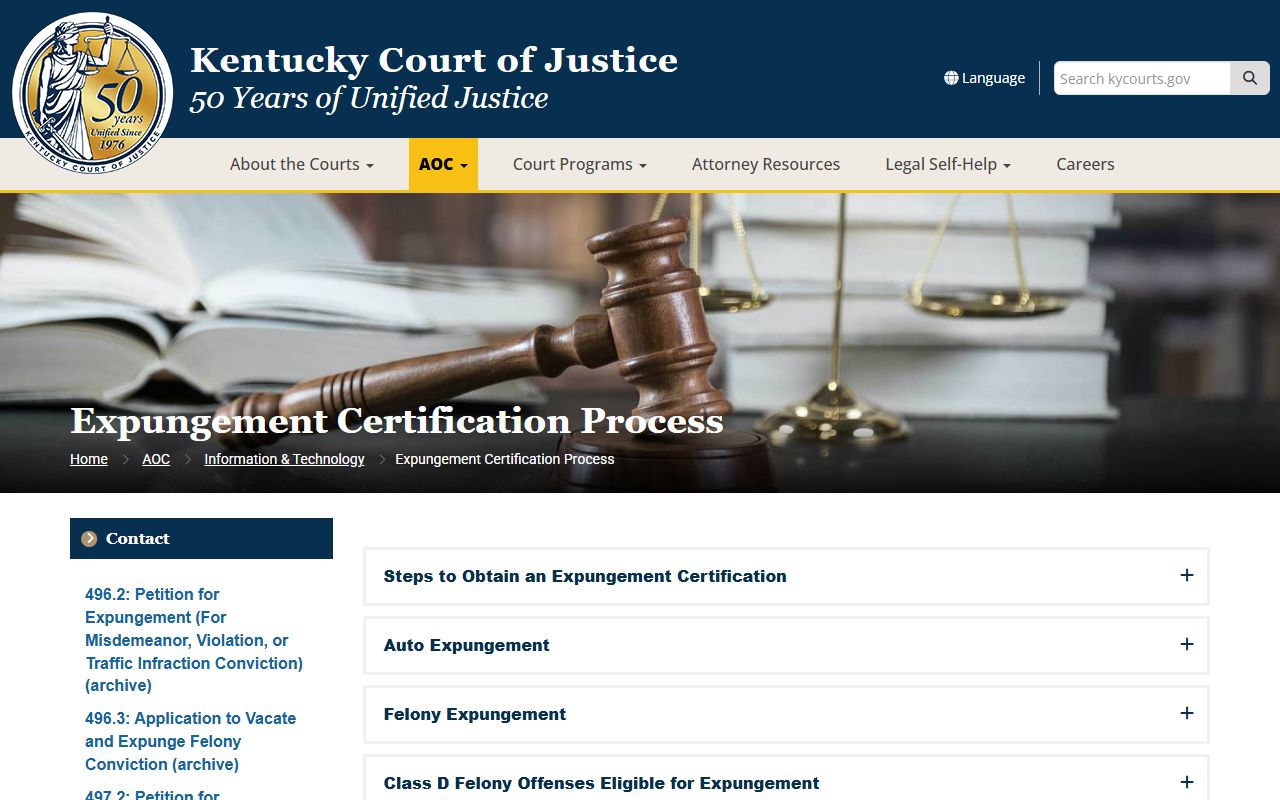
For a Lawrence County judgment, the petition stage is tied to the county where the judgment was entered after the statewide certification step.
Sealed vs Expunged Criminal Records
Sealed and expunged criminal records are not the same. A sealed record is hidden from general public access by law or court order. An expunged record may be removed, deleted, or sealed from public state-performed background checks under Kentucky law. Juvenile, adoption, mental-health, and some family-linked criminal records may have separate limits.
| Point | Sealed | Expunged |
|---|---|---|
| Public Visibility | Hidden from general public access. | Removed or treated as unavailable in public state-performed checks. |
| Authority | Court order or specific confidentiality law. | Kentucky expungement statutes and court process. |
| Local Route | Ask the Circuit Court Clerk about access limits or needed court order. | Complete certification, then file in the county of judgment when eligible. |
The Kentucky expungement statute chapter lookup is also part of the criminal record research set.
Those statutes support the access limits that can remove some Lawrence County criminal court records from public search.
Lawrence County Criminal Case Offices
Felony prosecution for Lawrence County is handled by the Commonwealth's Attorney for the 24th Circuit, covering Johnson, Lawrence, and Martin counties. The Kentucky Attorney General directory lists Hon. David Runyon at 704 Broadway, Suite B, P.O. Box 596, Paintsville, KY 41240, phone 606-788-7085. County-level prosecution and some misdemeanor, juvenile/status, traffic, and county legal matters involve the Lawrence County Attorney, Johnny Osborne, phone 606-638-4051.
The Kentucky Attorney General prosecutor directory is the official prosecutor source used for this page.
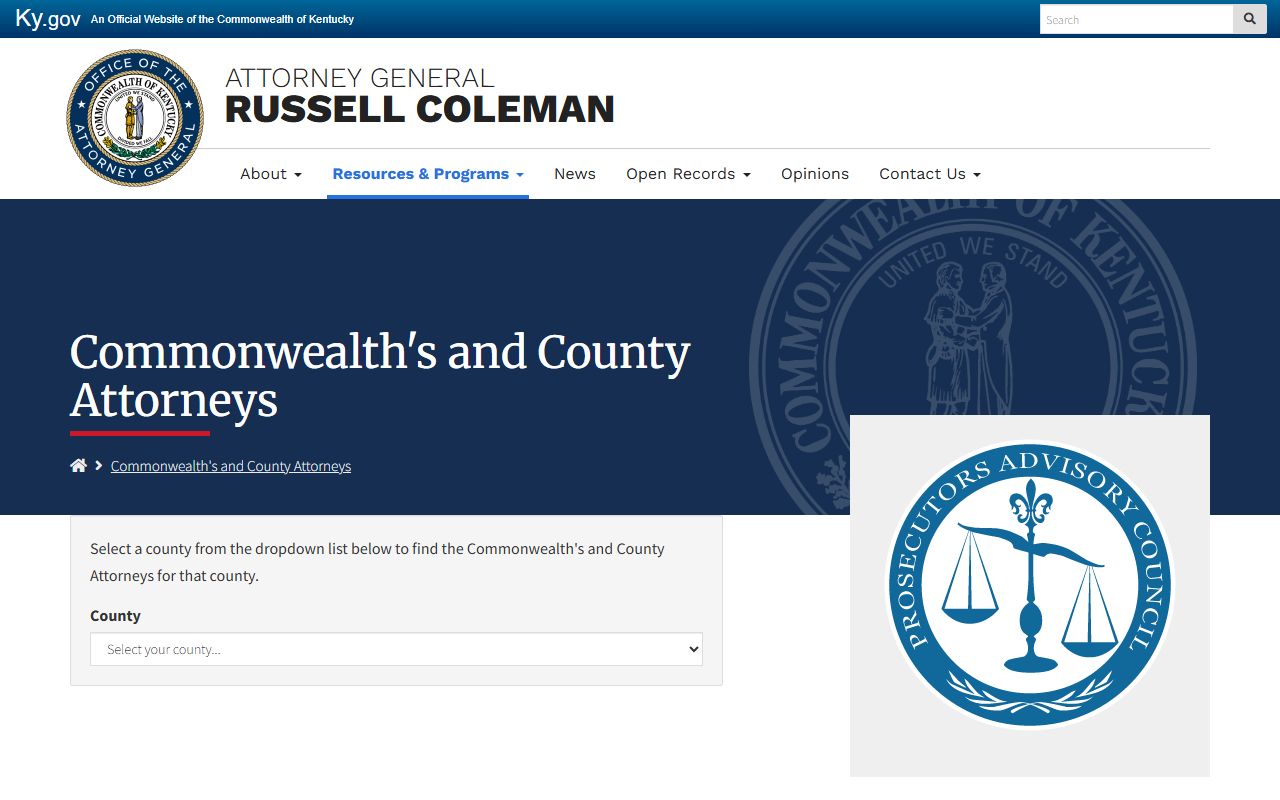
Public defense is through the Kentucky Department of Public Advocacy. DPA's official channels should be used to locate the current local office or assigned public defender for a Lawrence County case.
Public Access to Lawrence County Criminal Records
Public criminal court access relies on KYeCourts, CourtNet, docket search, and the Circuit Court Clerk. The Kentucky Open Records Act helps frame public-record access, but court case access still follows court rules, clerk procedures, redaction rules, and sealing or expungement orders. KRS 61.870 defines public-record terms, while KRS 61.872 gives Kentucky residents inspection rights unless an exception applies.
Lawrence County criminal records also connect to agencies outside the clerk's office. The sheriff may hold law-enforcement records, Big Sandy Regional Detention Center may confirm current custody, VINE may provide custody notifications, and KOOL may show sentenced DOC offenders. Those channels do not replace the filed court case. They answer different questions about arrest, custody, prosecution, supervision, and public notification.
Note: Juvenile, sealed, expunged, adoption, and mental-health records should not be expected in public criminal search results.