
Lawrence County Probate Records
Kentucky District Court handles probate of wills and many probate proceedings. Circuit Court handles contested probate matters. For Lawrence County, probate records and filings are part of the District and Circuit court system at the Lawrence County Judicial Center, with the Circuit Court Clerk serving as the case-record counter.
Probate-adjacent records may also appear with the County Clerk. The Lawrence County Clerk's land-recording fee schedule includes fees for wills, renunciation of will, disclaimer of will, affidavits of descent, inheritance tax liens, and powers of attorney. That does not make the County Clerk the court probate file custodian, but it does make the County Clerk relevant for recorded instruments tied to estates.
The practical rule is to start with the court clerk when the record is a probate case file and start with the County Clerk when the record is a recorded instrument. Estate disputes, contested wills, guardianship case material, and court orders belong on the court side. Recorded wills, affidavits of descent, tax liens, and powers of attorney may be checked through the county clerk's recording side.
Lawrence County Probate Terms
Probate records use terms that identify the person who died, the person handling the estate, and the type of court relief requested. These terms help separate a will filing from a guardianship, a creditor claim, or a contested estate case.
One file may use several of these terms. A petition may ask the court to admit a will and appoint an executor. A later filing may list an inventory, a claim, a settlement, or a dispute over the estate. In guardianship or conservatorship matters, public access can be narrower because protected-person details may be sensitive.
- Testator
- The person who made a will.
- Executor
- The person named in a will to carry out estate duties.
- Administrator
- A person appointed when there is no executor available.
- Intestate
- Dying without a valid will.
- Guardianship
- A court matter involving care or decisions for a minor or protected person.
- Conservatorship
- A court matter involving management of property or finances for a protected person.
Search Lawrence County Probate Records
Use multiple channels because probate access can split between online court search, docket lookup, court clerk files, and recorded instruments. Guest access may not show older, restricted, or stored records, so the clerk remains the official source for verification.
Have the decedent name, approximate date of death, case number if known, fiduciary name, and type of record needed before contacting an office. For recorded instruments, also ask whether the document is indexed under a grantor, grantee, estate, fiduciary, or decedent name. For court files, ask whether the matter is District Court probate or a contested Circuit Court matter.
- Search KYeCourts or CourtNet if the probate case is public and indexed in the state court system.
- Use the public docket search for scheduled Lawrence County probate hearings by county, division, and date.
- Call the Lawrence County Circuit Court Clerk for probate case files, older records, certified copies, or records not visible online.
- Contact the Lawrence County Clerk for recorded wills, affidavits of descent, powers of attorney, liens, and land-record instruments.
- Use a written open-records request only for County Clerk records in that office's custody, not for restricted court case material.
The Lawrence County Clerk land records and recording page is relevant for probate-adjacent recorded instruments.
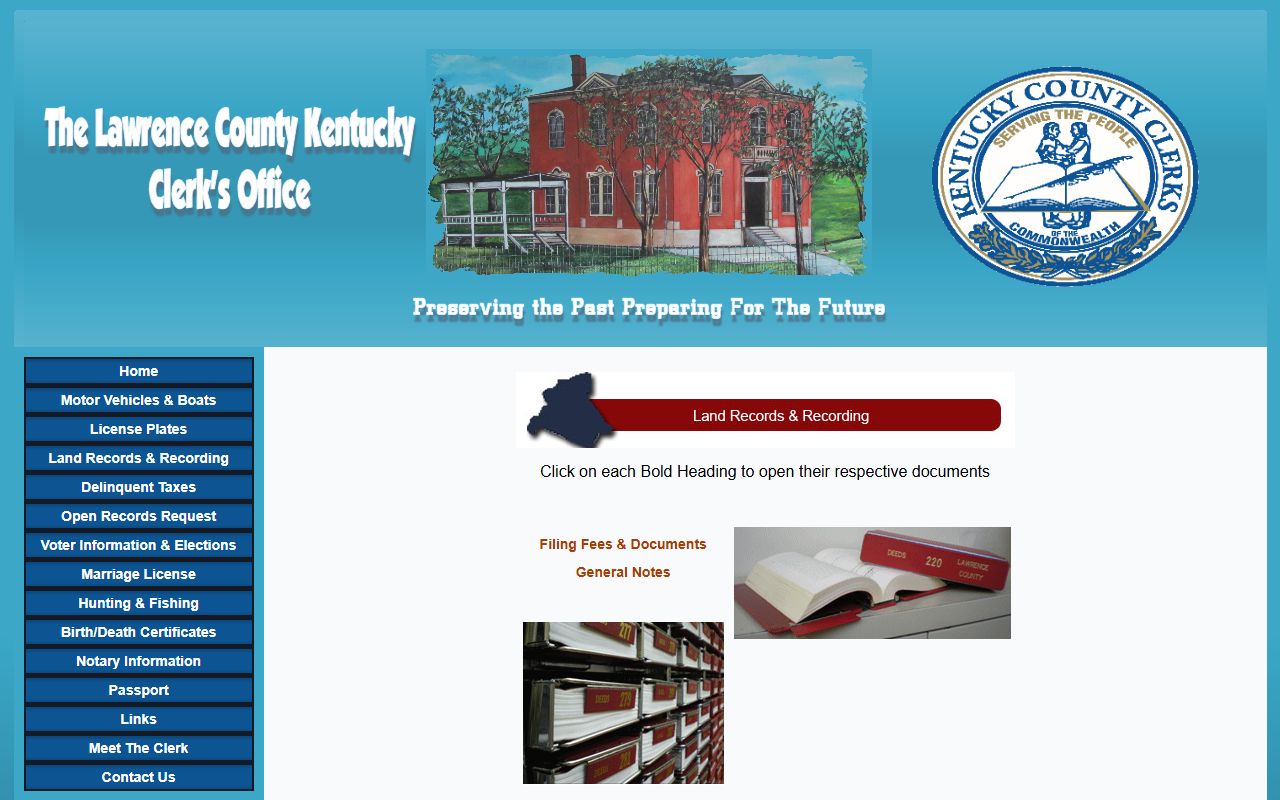
Land-record pages can help with recorded instruments, but court probate files still route through the court clerk.
Lawrence County Probate Courts
Uncontested probate and will matters start with District Court jurisdiction. Contested probate moves through Circuit Court jurisdiction. Both court records are handled through the Lawrence County Circuit Court Clerk at the Judicial Center.
Lawrence County's primary trial court is Circuit Court, but Kentucky District Court has specific probate jurisdiction for wills and many estate matters. This is why the probate page uses District Court probate jurisdiction while still pointing users to the Circuit Court Clerk as the office that handles court case records at the Judicial Center.
Lawrence District Court Probate Jurisdiction
29 River Bend Road
Louisa, KY 41230
606-638-4215
Monday-Friday 8:30 a.m.-4 p.m.
Lawrence Circuit Court Contested Probate
29 River Bend Road
Louisa, KY 41230
606-638-4215
Use for contested probate matters and civil estate litigation.
Lawrence County Clerk
122 Main Cross St.
Louisa, KY 41230
606-638-4108
Recorded wills, affidavits, powers of attorney, and liens.
Lawrence County Probate Fees
Research did not capture a Lawrence County court probate filing-fee schedule, will-safekeeping policy, small-estate instructions, or dedicated probate forms page. The fee table below uses the County Clerk land-recording fee PDF for probate-adjacent recorded instruments only.
For court filing costs, call the Circuit Court Clerk before preparing a filing. Court probate fees may differ from County Clerk recording fees, and the research did not provide enough official local detail to publish a court filing-fee table. For recorded instruments, the County Clerk's published fee schedule is the documented source.
| Probate-Related Instrument | Fee |
|---|---|
| Will | $47 |
| Renunciation of Will | $46 |
| Disclaimer of Will | $46 |
| Affidavit of Descent | $50 |
| Inheritance Tax Lien | $5 |
| Inheritance Tax Lien Release | $5 |
| Power of Attorney | $50 |
| Revocation of Power of Attorney | $46 |
What Lawrence County Probate Records Show
Probate files may include the will, petition to probate will, petition for appointment of executor or administrator, orders admitting a will, fiduciary bonds, inventories, creditor claims, accountings, settlements, guardianship and conservatorship filings, contested will pleadings, renunciations, and disclaimers.
Not every estate file contains each item. A simple estate may have a short set of filings, while a contested estate can have pleadings, motions, hearing notices, orders, evidence, and judgments. Guardianship and conservatorship files can include medical, financial, minor, or incapacity-related facts that may not be open in the same way as an ordinary will filing.
| Record Type | What It May Show |
|---|---|
| Will | Testator, beneficiaries, executor nomination, signatures, and witnesses. |
| Petition | Requested probate action and party asking for appointment or relief. |
| Order | Judge's ruling admitting a will or appointing a fiduciary. |
| Inventory | Estate property reported to the court. |
| Claim | Creditor claim filed against the estate. |
| Accounting or settlement | Estate receipts, distributions, and fiduciary activity. |
| Guardianship filing | Protected-person information, which may be restricted. |
Lawrence County Probate Forms
Because local probate forms were not captured, use the Circuit Court Clerk for current filing requirements and the Kentucky Court of Justice legal forms catalog for statewide forms where applicable. Contested estate matters may need counsel because Circuit Court jurisdiction can involve pleadings, motions, evidence, and orders like other civil cases.
The research did not capture Lawrence-specific small-estate thresholds, local judge preferences, bond-waiver rules, publication requirements, or fiduciary accounting deadlines. Those are material details, so they should come from the clerk, a current official form, or legal counsel rather than from a generalized Kentucky probate summary.
The Kentucky Court of Justice legal forms catalog is the statewide form source for probate-related filings.
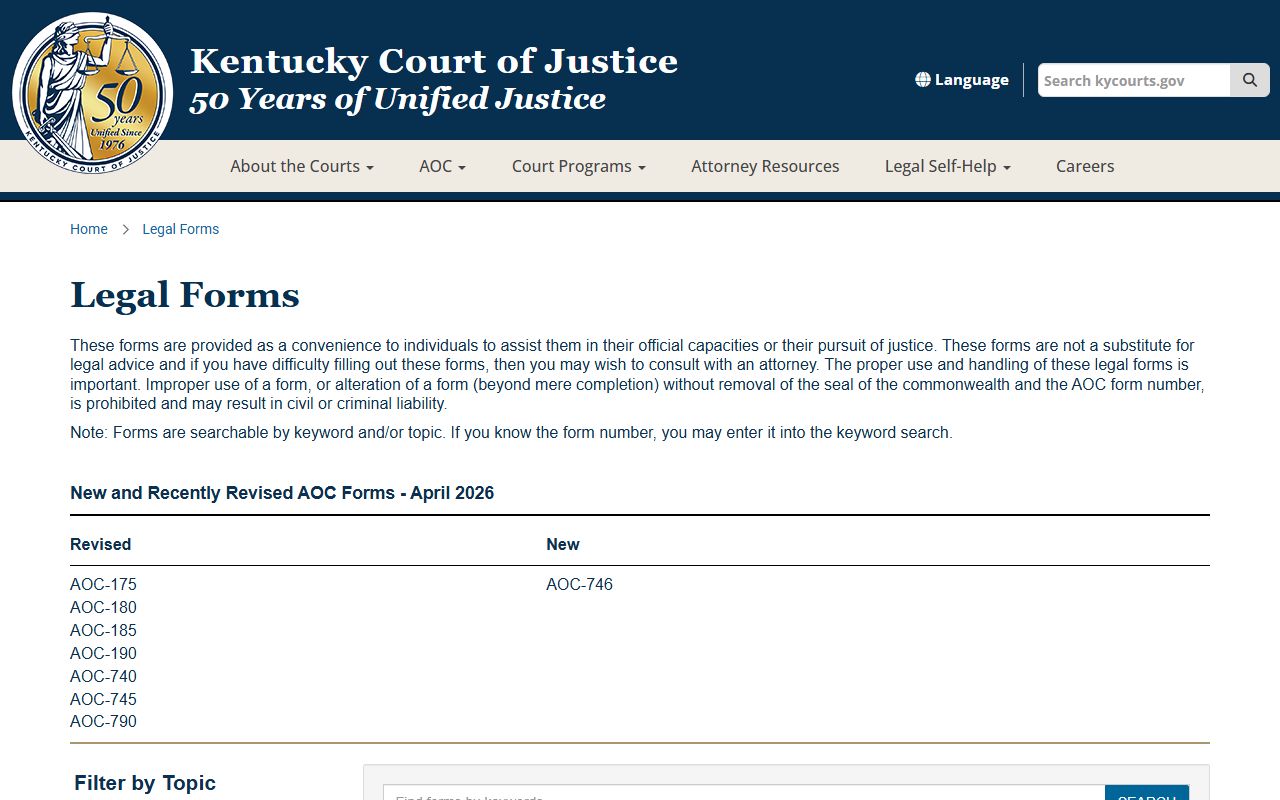
The forms catalog is a starting point, but the clerk should confirm which forms fit a Lawrence County probate filing.
Restricted Lawrence County Probate Records
Guardianship, conservatorship, minor, incapacity, mental-health, and sealed estate materials may be limited. Public search may show only part of a file or no file at all. A clerk may require party status, attorney status, court order, or in-person review before releasing sensitive probate records.
Open-records requests to the County Clerk can help for clerk-held documents, but they do not override court restrictions on probate case files. The County Clerk's written request process also requires a clear description, Kentucky resident statement, and commercial-use disclosure when applicable. For court files, use the Circuit Court Clerk and follow court access rules.
When a probate search involves real estate, check both the estate case and the land-record side. A court order may appoint a fiduciary, while a recorded affidavit, deed, lien, or power of attorney may show how the property record was updated. The two records can be connected without being stored in the same office.
For contested estates, deadlines and hearings should be verified with the Circuit Court Clerk. Public docket search can help locate a date, but the official case file controls pleadings, orders, and party notices.
Older probate records may also require clerk assistance if the file is stored offsite, indexed differently, or retained under a court schedule. The court clerk can identify whether a public file is in the office, stored elsewhere, or unavailable under retention rules.
Note: Recorded instruments and court probate files are different records, so ask each clerk which office holds the item needed.